
Breaking News:
San Jose Continues it's Energy Efficient Progress with $4M in New Projects
Project Specs: The City of San Jose Energy Group housed in the Sustainability and Compliance Division of the Environmental Services Department is working to help the City achieve the following Green Vision goals in the municipal sector by the year 2022 (using a 2007 baseline year):
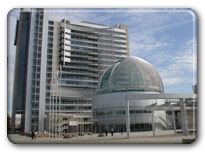 Green Vision Goal - Reduce energy usage by municipal facilities and streetlights by 50%.
- Green Vision Goal - Power 100% of municipal facilities and streetlights with renewable energy.
To achieve these goals, Energy Group staff drafted a Strategic Energy Action Plan approved by Council in 2010. You can see how they are doing on their progress toward achieving the Green Vision Goals.
Funding for Energy ProjectsSan José is currently using the following two main funding sources for municipal energy projects:
 Energy Efficiency and Conservation Block Grant — The project genesis began In December 2009, when the Energy Group was awarded an $8.8M Energy Efficiency and Conservation Block Grant (EECBG) through the Recovery Act. This funding was specified for use through 2012 for three projects: installation of LED streetlights, energy-efficiency projects at over 50 municipal facilities, and development of Request for Proposals for approximately 50 megawatts of solar on municipal facilities.
City Energy Fund
—  In order to support energy reduction opportunities at municipal facilities, the City Council established an Energy Officer position and an Energy Fund which now receives rebates and first and second year energy cost savings associated with energy-efficiency and renewable energy projects funded by the General Fund. Accumulated funds are used to pay for the Energy Officer and additional cost effective energy-efficiency and renewable energy projects. In 2010, the City adopted a Standard Operating Procedure for the Energy Fund.
City of San Jose Energy Projects include:
- LED Streetlights — An additional $2M in EECBG funding has been designated for the replacement of approximately 1,500 existing streetlights with "smart" LEDs equipped with dimmable and monitoring control systems.
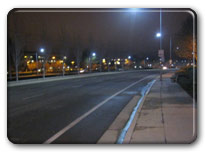 Solar Installations— At the City's Central Service Yard, a 1.3 MW solar installation will produce about 85% of the energy needs at the site.
- Water Pollution Control Plant Fuel Cell Installation — At the Water Pollution Control Plant, a 2.8 MW fuel cell system, fueled by a combination of waste gasses from the on-site digesters and the adjacent landfill, will produce emission-free electricity.
- Green Building Certification — A number of new and existing facilities will be certified under the nationally recognized U.S. Green Building Council's Leadership in Energy and Environmental Design (LEED) Rating System.

Hamden, Connecticut — Fuel Cell Installed in Hamden High School
Project Specs: The Town of Hamden, CT, has a clean energy goal of 20 percent by 2012. As part of this, a high school in Connecticut is now the home of a 400 kilowatt fuel cell system. The new fuel cell will add to two other green initiatives being implemented in Hamden, including a 4 kilowatt solar photovoltaic installation at the town's community center and another 5 kilowatt system at its middle school.
News link: 400 kilowatt Fuel Cell To Power Connecticut High School
Benefits and Advantages:
The fuel cell, provided by UTC Power, is part of a 10 year energy services agreement that has the company installing and operating the system at Hamden High School in Connecticut. According to UTC,
- The town chose a PureCell System Model 400 which incorporates UTC Power's latest technology and design innovations and builds on the company's unmatched fuel cell fleet durability and 10 million hours of operating experience.
- The 400 kilowatt fuel cell is expected to provide about 90% of the school's annual electricity needs and pump heat into the school's buildings and swimming pool.
- The fuel cell is meant to be operational by the end of this year.
- The town and its education officials anticipate that the 400 kilowatt fuel cell will reduce the school's energy costs by $800,000 over the 10-year duration of the contract.
- It will serve the additional purpose of functioning as part of the science curriculum offered at the high school.
- The fuel cell is expected to reduce the school's annual carbon dioxide emissions by more than 809 metric tons, which is reportedly equivalent to planting more than 187 acres of trees.
Project In-Depth: The fuel cell installation is reportedly being supported by a grant from the Connecticut Clean Energy Fund (CCEF) which gets its funding through the American Recovery and Reinvestment Act.
News link: Eastern Connecticut State University is also installing a
PureCell Model 400 kW, under a 10-year Energy Services Agreement (ESA)
The Model 400 provides customers with an industry-leading 90 percent system efficiency, 10-year cell stack durability and 20-year product life. "The Model 400 offers our customers lower energy costs, reduced emissions, 24/7 assured power and an industry-best system efficiency and product life. No other stationary fuel cell product in the field today can offer the same range of benefits," said Neal Montany, director of UTC Power's stationary business.
"UTC Power is proud to partner with the Town of Hamden, the Hamden Board of Education and CCEF on this project. We are thrilled that Hamden High School has plans to incorporate the technology and benefits of the Model 400 into the school's science curriculum. We believe it is important to teach students and the general public that our fuel cells are not the technology of tomorrow but are here today generating efficient, secure and clean power to familiar everyday places like schools, supermarkets, hospitals and hotels."
Encinitas, California — Energy Retrofit for the City of Encinitas Civic Center
Project Specs: As part of a recent energy retrofit for the City of Encinitas' Civic Center, designers and engineers considered several eco-minded options that would reduce the center's energy consumption while lowering costs — and then employed them all.
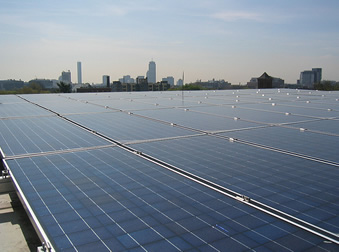
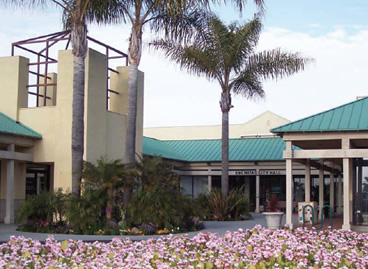 Installing photovoltaic panels on the building's rooftop was considered and incorporated.
 - Ditto, skylights and light tubes.
- But perhaps the pièce de résistance is a thermal energy storage solution that keeps the building cool using hardly any electricity during the day.
- 96 kW Solar PV on roof. This provides "free" power during the most expensive time of day.
- Addition of a "cool roof" over the existing to reflect heat.
- New 120-ton water-cooled central plant along with new 4-pipe air handlers.
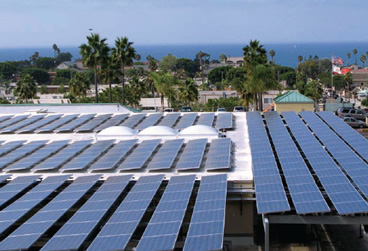 New Thermal Energy Storage (TES or Ice Storage). This makes and stores the chilled water at night when the electrical rates are half of what they are during the peak in the daytime.
 - Natural lighting including Solatubes and skylights.
- Lighting Controls
- The thermal energy storage system will reduce the center's utility bill by 74 percent.
- During the next 25 years, the project will save taxpayers an estimated $4 million in energy costs.
- Already, the system has won local green accolades, earning a San Diego Energy Efficiency award.
Project In-Depth: As part of the city's Energy Efficiency Improvements Project, CALMAC provided three IceBank® Energy Storage tanks to help the center towards their goal of reducing utility costs and energy consumption.
News link: A Cool Way to Cut Energy Costs
THERMAL ENERGY STORAGE SHIFTS ELECTRICITY DEMAND TO OFF HOURS
TO GIVE THE GRID A BREAK DURING PEAK TIMES
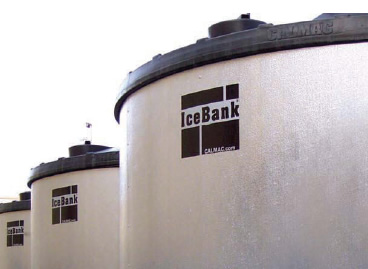 As part of the retrofit project, a hybrid cooling system, which included CALMAC's IceBank energy storage tanks and Trane's cool water system, was installed at the Civic Center, and reduced its energy costs by 43 percent. The hybrid cooling system makes and stores ice at night during off-peak times, when utility rates are far less expensive and when cleaner baseload plants are used. Chillers are rightsized to handle energy demand efficiently and stored energy kicks in when needed.
Apart from CALMAC's IceBank tanks, the project also includes alternative measures to reduce the civic center's energy use, including solar panels (photovoltaic), natural lighting and lighting controls. Facilitated by the CALMAC tanks, the civic center's greatest cost savings came from shifting the electrical demand from on-peak to off-peak periods.
An ENERGY STAR® Partner and USGBC member, CALMAC is a leading manufacturer of IceBank® Energy Storage equipment with over 3,300 Ice Storage installations worldwide. IceBank systems enable energy, including renewable wind energy which mainly blows at night, to be efficiently stored for use during periods of high demand.
Corvallis, Oregon — COGEN at Oregon State University
Project Specs: The OSU Energy Center, which became fully operational in June 2010, replaced a nearly 90-year-old heat plant with failing boilers and serious seismic issues. The new plant is a cogeneration facility that combines heating and electricity generation, allowing OSU to generate nearly half of its electrical needs on site. The approach is calculated to lower the university's energy costs by around $650,000 a year, not to mention dramatically reducing its carbon footprint.
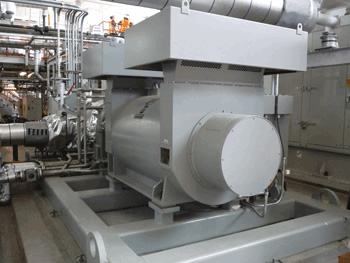
Benefits and Advantages: Jacobs Engineering Group Inc. designed a new 6.5 Megawatt (MW) cogeneration power plant that has the following advantages:
- It increases OSU's energy production efficiency. When that excess heat is captured and used properly, the power plant can be made 89% efficient, a large and important increase.
- The power it generates is clean, consistent, and unlikely to spike.
- The technology is compatible with other renewable technologies and monitoring products.
- The heat by-product is recovered through a highly efficient process in the form of hot water or low pressure steam. At OSU, the steam generator 's excess heat capture system creates hot water, radiant heating, and heat for the University's boilers.
Project In-Depth:The new Energy Center has just received Platinum LEED certification, the highest certification possible. The list of features that helped the building gain Platinum LEED status includes
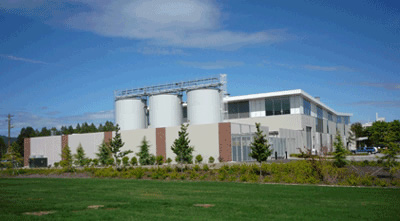 A white reflective roof
- Water-efficient landscaping
- The use of recycled building materials
- Recycling a majority of the project's construction debris<
- A rainwater harvesting system that is used for the boilers
- Radiant heating
- Hot water generated by heat recovery from the steam system
- Natural lighting and ventilation
- Building energy use that is 52 percent better than the Oregon building code
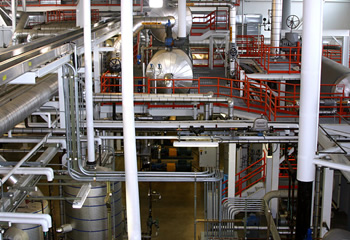 The plant runs on natural gas with a diesel backup, but it can also run on biodiesel and methane. The plant uses a natural gas-fired turbine and heat recovery steam generator to produce power, and uses the waste heat generated when creating electricity at the plant to heat the campus. The plant is also is expected to reduce CO2 emissions by 38 percent relative to the old plant. In addition to its heating and energy producing roles, the Energy Center also will be a learning lab for OSU students.
The project was funded by a combination of bonds, gifts, grants, energy tax credits and university funds. Some of the bond money will be repaid through energy savings.
Rome, New York — Modernized Wastewater Treatment Plant
Project Specs: In 2008, The City of Rome, NY, needed to Fix the wastewater treatment plant to increase capacity and function, and Implement a broad range of city energy efficiency upgrades.Benefits and Advantages: The city reached an agreement with Johnson Controls, and under a new 15-year performance contract:
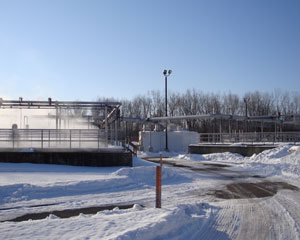 Expanded and modernized the wastewater treatment plant, and implemented a broad range of city energy efficiency upgrades.
- They are using savings from these efforts to help fund the projects rather than raise taxes.
- The projected utility cost savings under a 15-year performance contract to expand and modernize the city's wastewater treatment facility and from a broad range of energy efficiency improvements to city buildings is $8.6 million.
- The savings generated during the construction phase of the project is $246,000.
- Estimated annual savings from an improved, more energy-efficient wastewater treatment plant is $100,000.
Project In-Depth:In 2007,The City of Rome, NY, collaborated in a performance contract with Johnson Controls that resulted in numerous energy efficiency improvements, such as upgraded lighting, a new more efficient boiler, and deployment of an energy management system. Those improvements paid for themselves by lowering utility costs by approximately $2.8 million over the term of the agreement.
| News link: Rome, New York self-funds infrastructure improvements through energy cost savings | PDF link: Wastewater treatment plant expansion cuts energy costs through self-funding project |
Johnson Controls modernized the wastewater treatment plant, replacing old mechanical aerators with a state-of-the-art fine bubble aeration system and adding new, more efficient blowers and other components that significantly reduced the plant's energy consumption. In addition, Johnson Controls improved the energy efficiency of numerous city buildings, including City Hall, the central fire station, police department offices, and the Rome Arts Center. This included installing new boilers, high-efficiency lighting, and automated energy management systems. The resulting estimated utility savings are expected to enable the city to make these improvements at no cost to local taxpayers.
Project financing came from a tax-exempt municipal lease made possible by New York State's Energy Performance Contracting Legislation which applies to city-owned facilities.
Allegheny County, Pennsylvania — Comprehensive Energy Services
Project Specs: Under a master Energy Savings Performance Contract (ESPC), NORESCO is providing comprehensive energy services for more than 100 of Allegheny County's facilities in four phases. Facility Description: County government, 100+ buildings, more than 3.43 million square feet.Benefits and Advantages:Allegheny County expects to save nearly $13.7 million in energy operating costs over the next 10 years. The new energy-efficient equipment and retrofits required to realize these savings will not cost taxpayers apenny, because financing was arranged entirely from the energy-cost savings - with no down payment or up-front charges.
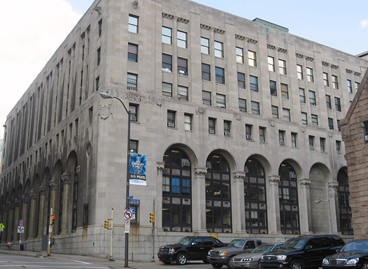 Energy to be saved from the pilot project through Phase II of the program will exceed 20 million kwh of electricity per year, more than 29,000 MCF of gas per year, and more than 90 million gallons of water per year.
Project In-Depth:The pilot project, which is saving about 2.1 million kilowatt-hours (kwh) of electricity and 5,600 million cubic feet (MCF) of natural gas, included:
- Installing an energy management system at the Shuman Juvenile Detention Center.
- Retrofitting the lighting system at the detention center.
- Replacing two aging chlorofluorocarbon (CFC)-based chillers with less environmentally harmful and more efficient chillers, and refurbishing the cooling tower at the Shuman Center.
- Installing a new refrigerator condenser and new gas kitchen equipment at the detention center.
- Installing energy-efficient lighting and windows at the health department offices.
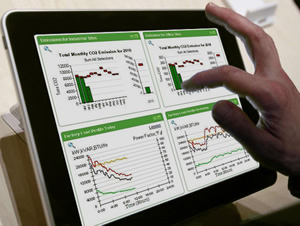 Phase I is designed to conserve about 40 million gallons of water, 6,673,616 kwh of electricity and 8,990 MCF of gas annually. It encompasses:
- Retrofitting almost 20,000 lighting fixtures at the county's five downtown Pittsburgh facilities.
- Installing new energy management systems and controls at the four Kane Regional Medical Centers and the North Park Ice Skating rink, and programmable thermostats at various North Park facilities.
- Replacing inefficient kitchen equipment at the Kane Centers.
- Installing over 600 low-flow water-saving toilets, 1,100 faucet restrictors, 31 low-flow shower heads, and new laundry systems and front-load washers at the four Kane Centers and Shuman Juvenile Detention Center; doing maintenance and repair work on the North Park water distribution system.
- Replacing a cooling tower at the county court house.
- Performing a cogeneration study for the downtown facilities and airport industrial park complex.
Atchison County, Missouri — The Loess Hills Wind Farm for Rock Port
Project Specs: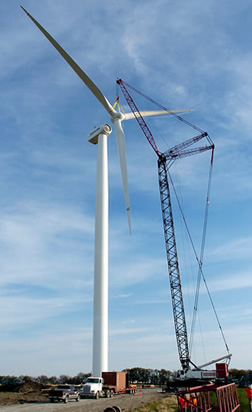
- Capacity: 5 megawatts (MW) Power
- Purchaser: Missouri Joint Municipal Electric Utility Commission
- Commissioned: Spring 2008
Benefits and Advantages:This wind farm is the smallest of Wind Capital Group's four operating wind farms in northwest Missouri. Nevertheless, Loess Hills garnered attention because it produces more power for the town of Rock Port than the town and its residents use. Therefore, Rock Port has been called the first 100% wind powered town in America.
Technology
- Turbine Model: Suzlon S-64
- Turbine Rating: 1.25 megawatts (MW)
- Number of Turbines: 5
Output Details
- Number of Homes Powered: Approximately 1,400 - the entire town of Rock Port, Missouri
- CO2 Savings: Approximately 10,000 metric tons/year
- Equivalent Cars off Road: Approximately 2,000/year
Project In-Depth:The Loess Hills Wind Farm was completed in spring 2008, producing enough electricity to make Rock Port, Missouri, the first community in America capable of meeting its entire annual electricity demands from wind power. The 5 megawatt (MW) wind project built on agricultural lands within the city limits of Rock Port in Atchison County includes four Suzlon S-64, 1.25 megawatt (MW) wind turbines.
Rock Port is a member of the Missouri Joint Municipal Electric Utility Commission (MJMEUC) that supplies power for 56 municipal utilities throughout Missouri. The Loess Hills Wind Farm is interconnected with the Rock Port Municipal Utility 12.4 kV (12,400-volt) distribution system.
Loess Hills benefited during construction from the economies of scale offered by the construction of Wind Capital Group's nearby Cow Branch Wind Farm. Both projects were built at the same time and shared the same contractor.
Customers of the Rock Port utility also benefit from a reduction in electrical transmission charges previously paid to bring power to the city. The four turbines are producing approximately 16 million kilowatt hours (kwh) of electricity every year, which is 3 million kwh more than the city is expected to use.
Madison County, NY — Solar Installation on a Landfill
Project Specs: Madison County, owners of the Madison County landfill, needed to develop a sustainable landfill closure system that generates clean solar energy. The cap was for Cells I through 4 of the West Side Landfill. The total capping project included approximately 8 acres with approximately 1 acre of south facing side slope.
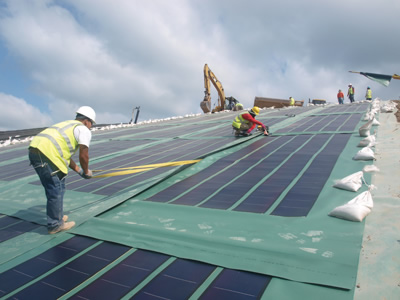 The County also had to meet New York State Department of Environmental Conservation regulations. The County sought out ideas for alternative capping systems that would meet their capping needs, while providing additional environmental and/or operational benefits.
Benefits and Advantages:With much of the closure area located on a southern facing slope, Carlisle Energy Services of Carlisle, PA, and Barton and Loguidice Engineers of Syracuse, NY, responded to the County's request by designing an innovative solution:
- The cap includes an exposed flexible membrane photovoltaic system as an integral part of the landfill closure project.
- The photovoltaic system is approximately 1/3 acre of composite of flexible solar panels, 1/2 acre of thermoplastic polyolefin geo-membrane, and associated wiring capable of generating approximately 40 kW of electrical energy primarily for use on the site.
- The project has been sized to match the power output with the power consumption required to operate the County's Materials Recycling Facility located adjacent to the landfill. This effectively allows the County to provide environmentally secure closure to the waste within their landfill and supplement their on-site renewable energy generation, with the additional value of a significant reduction in the operating cost of their County-wide recycling facility.
- A net metering agreement allows them to feed excess electricity to the local electrical grid.
News link: Carlisle Energy Services: Madison County, NY Landfill Solar Project Now Completed |
PDF link: Madison County Landfill Solar Cap Project |
Project In-Depth:The County installed a geo-membrane cap on part of the landfill. While most of the side slope cap will be a combination geo-membrane and vegetated cap, the south facing slope was suitable for a PV array that will be affixed directly to the exposed cap geo-membrane material. Eleven solar panels were placed on the southern facing slope of the closed west side landfill at the Buyea Road Landfill site in the Town of Lincoln.
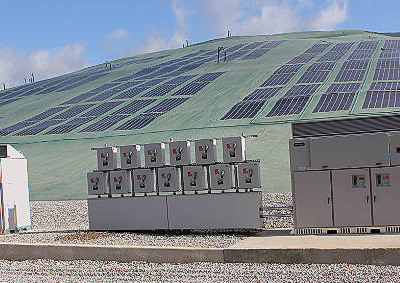 The Geo-membrane on the south facing slope is a scrim reinforced thermo plastic olefin (TPO) material that is often used on large flat top building roofs. The 144W thin-film flexible PV modules is glued to the TPO either at the factory, or on site.
This type of PV integrated capping system has been installed on another large landfill cap in Texas, and has been installed on numerous large building roofs. Manufacturers are currently making systems that are modular and utilize "plug-and-play" components to more quickly connect the system. In this case, PV modules were wired to inverters that will be connected to generate three phase AC power, and a step up transformer brings the voltage up to 480 volts as it is transmitted to the MRF eclectic meter.
The County will be able to utilize the energy generated through the solar array to offset the power requirements of the equipment located within the Recycling Facility. Any excess-electricity generated through the solar modules will be net-metered to the grid. It is estimated that the 50kW system will generate approximately 50,000 kWh power year; offsetting existing electric demand at the Madison Recycling Facility. The current electric usage of the MRF facility is approximately 49,000 Kwh/year, which is close to the proposed output.
The total estimate project cost is about $380,000, most of which will be funded by a New York State Energy Resource Development Association (NYSERDA) Grant.
The Madison County landfill is the first municipal landfill in the country to apply this technology in a closure project. Future plans for the site, referred to as the Madison County Agriculture and Renewable Energy Park, include a one-megawatt landfill gas system that captures the heat generated by the turbine engines to dry lumber on site and heat the building. Other on-site green energy programs are being considered such as the possibility of adding a windmill, hydroponic greenhouses, and/or an additional solar array.
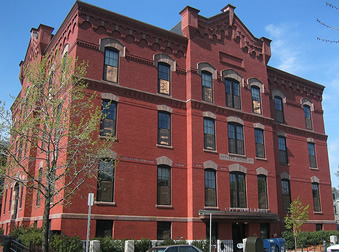 Cambridge, Mass. — A Ground Source Heat Pump, Geothermal Energy at Work!
Project Specs: Cambridge's First Municipal Green Building - the revitalization of the City Hall Annex is an innovative project in which a historic public building was preserved and renovated with the latest in environmental design and technology.
Benefits and Advantages:Under the leadership of City Manager Robert W. Healy, the City of Cambridge teamed with HKT Architects and Consigli Construction to demonstrate leadership in green municipal design.
News link: Cambridge's City Hall Annex is the Oldest Green Building Worldwide
 The Annex was built according to guidelines set by the U.S. Green Building Council (USBGC) Leadership in Energy and Environmental Design (LEED) program. The building's "green" features help reduce energy consumption by almost 50% compared to a conventionally constructed building.
Project In-Depth: The building houses five City departments- the Animal Commission, the Cambridge Arts Council, the Community Development Department, the Conservation Commission, and the Traffic, Parking & Transportation Department. No Furnace or Boiler: A ground source heat pump system in three 1200-foot deep wells provides all heating and cooling. There is no boiler or furnace in the building.
Ramapo, New York — Solar Wall Installation at Rockland Waste Management
Project Specs: The Rockland County Solid Waste Management Authority administers and treats the solid waste from wastewater that is generated within the county. The co-composting facility is one of the buildings that they administer, and in 2005, Dvirka & Bartilucci (D&B) Consulting Engineers were tasked with overseeing a series of process, structural, and energy efficiency improvements.
|
PDF links: Rockland / Ramapo Project Fort Drum, NY military base Project (world's largest) |
|---|
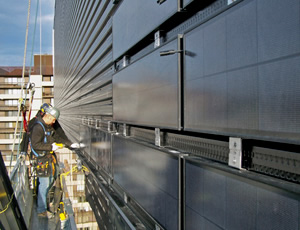
Benefits and Advantages:As part of the energy efficiency improvements, D&B Engineers investigated commercially available solar heating systems to offset the large quantities of energy required in the waste drying application. They recommended the SolarWall® technology from Conserval Engineering (Buffalo, NY), which is ideally suited to commercial process drying applications. SolarWall® systems were installed on the southeast and southwest walls to provide heat to two 3-million BTU/hr oil-fired heating systems.
 Energy Savings: 1,475 MMBTU / year
 - Heating Oil Displacement: 14,100 gallons / year
- CO2 Displacement: 165 tons / year
Project In-Depth: The overall project was divided into three systems, and is summarized below. SolarWall® System One: 1,265 ft2 (118 m2) of panels were installed on the southeast wall. 11,000 cfm air is preheated and connected to the oil heater on the northeast corner of the facility; SolarWall® System Two: The solar collector area is 3,815 ft2 (355 m2) on the southeast facing wall. 17,500 cfm of air is preheated and delivered to the second oil heater on the southwest corner; SolarWall® System Three: Covers 2,900 ft2 (270 m2) on the southwest wall. Designed for preheating 17,500 cfm of air, which is also connected to the second oil heater. More Details at Solarwall.com
South Carolina Schools — Lighting, Energy Efficiency, HVAC Improvements
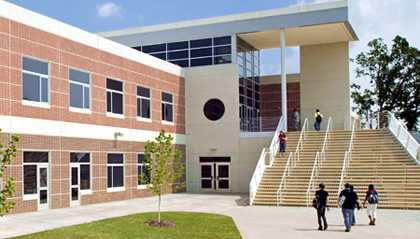 Project Specs: In 2010, the state of South Carolina needed to improve lighting, energy efficiency, heating and cooling, and controls for throughout its school districts and juvenile justice systems.
Benefits and Advantages:The state made an investment of nearly $3,200,000 across multiple buildings that included a wide variety of energy efficiency projects.
- The school district is heating, cooling and lighting 1.1 million more square feet than it was in 2006, but using 1.2 million fewer kilowatt hours (KWH) to do it, the Bluffton school board learned June 9, 2011.
- Bluffton is only one of many towns involved.
- In May, the district paid $402,972 in energy costs, compared to $422,051 in May 2006 - a savings of $19,259.
- The yearly comparison between 2011 and 2006 will be available after the fiscal year ends at the end of this month. "Every year's been a dramatic improvement, but I think you're going to see more of an improvement comparing 2009-10 to 2010-11," said Jack Thompson, energy manager for Beaufort County Schools, who works for the district's school maintenance contractor, GCA Educational Services of Knoxville, TN.
- Thompson said that while taxpayers are seeing energy savings, students are also breathing cleaner air.
Project In-Depth:South Carolina Schools and Juvenile Justice System in 2010 made a large investment in their facilities, including:
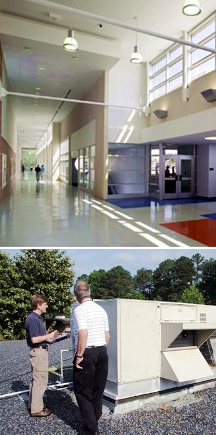 1/22/2010 FLORENCE COUNTY SCHOOL DISTRICT 4 $68,159.00 Install monitoring controls on the Cooler/Freezer; Replace in the HVAC system; Replace T-12 lighting fixtures with T-8 fixtures.
 - 1/22/2010 DILLON COUNTY SCHOOL DISTRICT 1 $58,647.00 Implementation of selected lighting fixture upgrades; Implementation of new HP units with energy recovery ventilator
- 1/22/2010 BARNWELL COUNTY SCHOOL DISTRICT 19 $63,076.00 Replace lighting fixtures in Elementary and High School @ Blackville-Hilda Schools
- 1/22/2010 BAMBERG COUNTY SCHOOL DISTRICT 2 $82,239.00 Install new Direct Digital Control System in Denmark-Olar High School
- 4/8/2010 CORRECTIONS, SC DEPARTMENT OF $2,312,049.00 Various energy saving measures at Lee & Kershaw Facilities including perimeter lighting, purchase & install variable freq drives; occupancy office sensors; retractable pole lighting; water heater replacement
- 4/20/2010 DENMARK TECHNICAL COLLEGE $100,000.00 Lighting Upgrades to 3 campus buildings
- 4/21/2010 MCCORMICK COUNTY SCHOOL DISTRICT $24,721.00 Upgrade lighting with electronic ballasts and T8 lamps for fluorescent fixtures and CFLs for incandescent lamps; Install programmable thermostats in higher usage buildings; Replace window units with HVAC units in Adult Ed Bldgs
- 4/21/2010 ORANGEBURG COUNTY SCHOOL DISTRICT 4 $136,876.00 Update remote monitoring and alert for HVAC at Hunter-Kinard-Tyler Unit School to wide area networking controls2/2010 TECHNICAL COLLEGE OF THE LOWCOUNTRY $81,966.00 HVAC Equipment Replacement; lighting retrofit-LED exit sign; lighting retrofit - T12 to T8 fluor fixtures replacements; lighting retrofit - occupancy sensors (at Beaufort Campus); install new direct digital controls at Hampton Campus.
- 4/22/2010 ANDERSON COUNTY SCHOOL DISTRICT 4 $83,884.00 Replace 22 Heat Pump Split systems with higher SEER rating at Pendleton Elementary and High School.
- 4/22/2010 COMMISSION FOR THE BLIND, SC $58,316.00 Chiller overhaul with PM Plan & five-year extended warranty @ Bull Street Campus, Columbia.
- 4/28/2010 SPARTANBURG SCHOOL DISTRICT 1 $97,318.00 Replacement of existing two pipe HVAC system at New Prospect Elementary School with packaged self contained heat pumps; replace metal halide light fixtures @ Inman Intermediate & Elem Schools and O.P. Earle Elem School.
- 5/12/2010 WILLIAMSBURG TECHNICAL COLLEGE $54,051.00 Upgrade T-12 Lighting to T-8; Install Occupancy Sensors in classrooms and most office areas; Replace 1-15 ton unit and 2-12.5 ton units.
- 5/25/2010 USC SUMTER $89,212.00 Energy measure includes metering, HVAC controls, and lighting controls at the Anderson Library on the USC Sumter Campus, the single largest energy consumer on campus.
Enterprise, Alabama — Public Works Facility Adds Biodiesel Production Facility
Project Specs:- Location: Enterprise, AL
- Capacity: 70,000 gal Biodiesel annually
- Rye Brook, N.Y.-based Parsons & Whittemore is building the plant near its Alabama River Pulp Co. mill along the Alabama River
Benefits and Advantages:The ceremonial groundbreaking for the $15 million project was in early October.
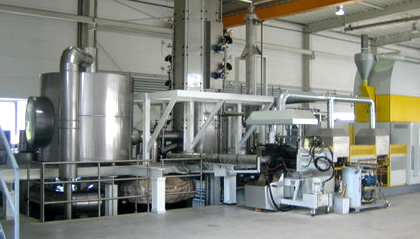 The plant was initially announced at 20 MMgy, but has since been scaled to 40 MMgy nameplate capacity.
 - Soy oil will be the facility's primary feedstock, but the plant will be flexible to handle other sources.
- The plant is expected to annually use the oil produced from more than 27 million bushels of soybeans.
- The city fueling station, which provides fuel for 85 city diesel fleet vehicles, six mental health and seven rescue squad diesels, will now carry B20 for those same vehicles.
News link: Alabama's newest biodiesel plant opens in Enterprise

Project In-Depth:Employees at the Enterprise, Ala., Public Works Facility can add a new duty to their jobdescriptions: biodiesel production. After 15 years of development, the city officially announced its new biodiesel facility is up and running, with major supporter Gov. Bob Riley in attendance.
Businesses such as the Greenside Grill, McDonald's, and the local high school will all provide waste cooking oil to the plant, helping the community-scale biodiesel refinery, scaled at 70,000 gallons a year, secure local feedstock.
The plant has already received a $300,000 grant from the Alabama Department of Economic and Community Affairs, and anticipates partnering with surrounding communities for feedstock access and fuel supply agreements. The state helped this biodiesel facility come into being. Biodiesel can add jobs, clean the air, and recycle waste vegetable oil . It is a local fuel, and it is gaining popularity because it's good for the environment and can be used in almost any diesel vehicle built in the past 10 years.
MLC can help you lease the equipment you need. Send an email >